It all runs locally
Speech is recognised on your own processor. The network is needed exactly once - to fetch the model.
Dictation for macOS
Hold a key, talk, let go - the finished text lands wherever the cursor is. Recognition runs on the machine itself, so no audio goes anywhere. No account, no subscription, no cloud.
Requires macOS 26 or later.
Didn't install, or isn't working? Message me on Telegram or at , and I'll sort it out.
Why bother
Speech is recognised on your own processor. The network is needed exactly once - to fetch the model.
Not the audio, not the transcripts. There is no server and no account, so there is nothing to leak.
Metal where it exists, the CPU where it doesn't. Apple Silicon is not a requirement.
A non-commercial project. No tiers, no subscription, no cap on minutes.
How it works
The sequence is the same in every app: mail, a code editor, a chat window, a search field.
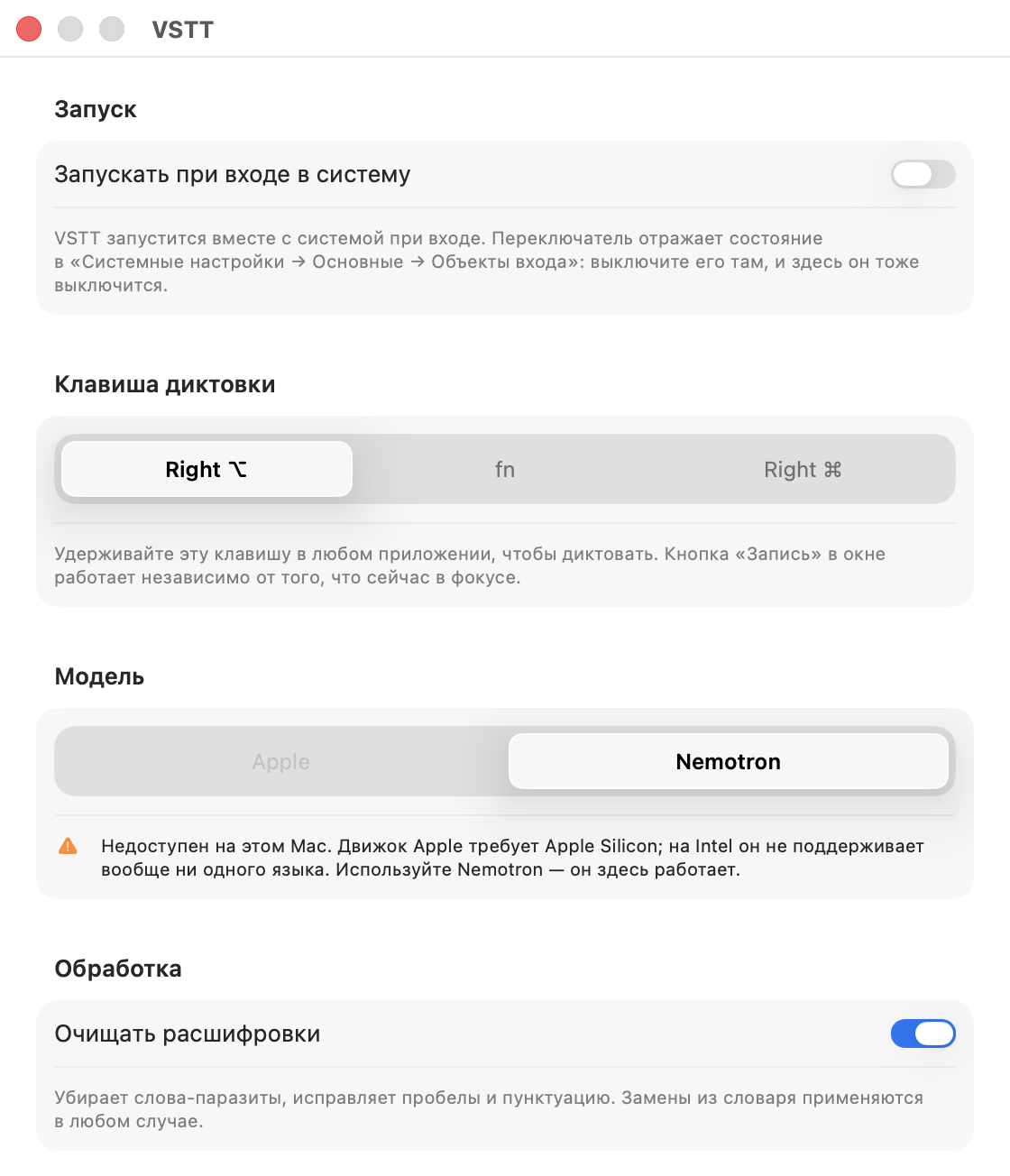
Right ⌥ by default. Settings can switch it to fn or Right ⌘.
The model streams: words show up in the floating capsule while you are still talking.
Let the key go and the recording ends, with the transcript finished off.
Cleaned-up text is inserted into the focused field. A copy stays in the history.
The engine
The model runs locally through transcribe.cpp on top of ggml - Metal when it is available, CPU otherwise. That is exactly why the app works on Intel Macs.
MEASURED ON AN INTEL MAC 4.3 s of speech → 1.3 s to transcribe ≈3.3× realtime
Inside the app
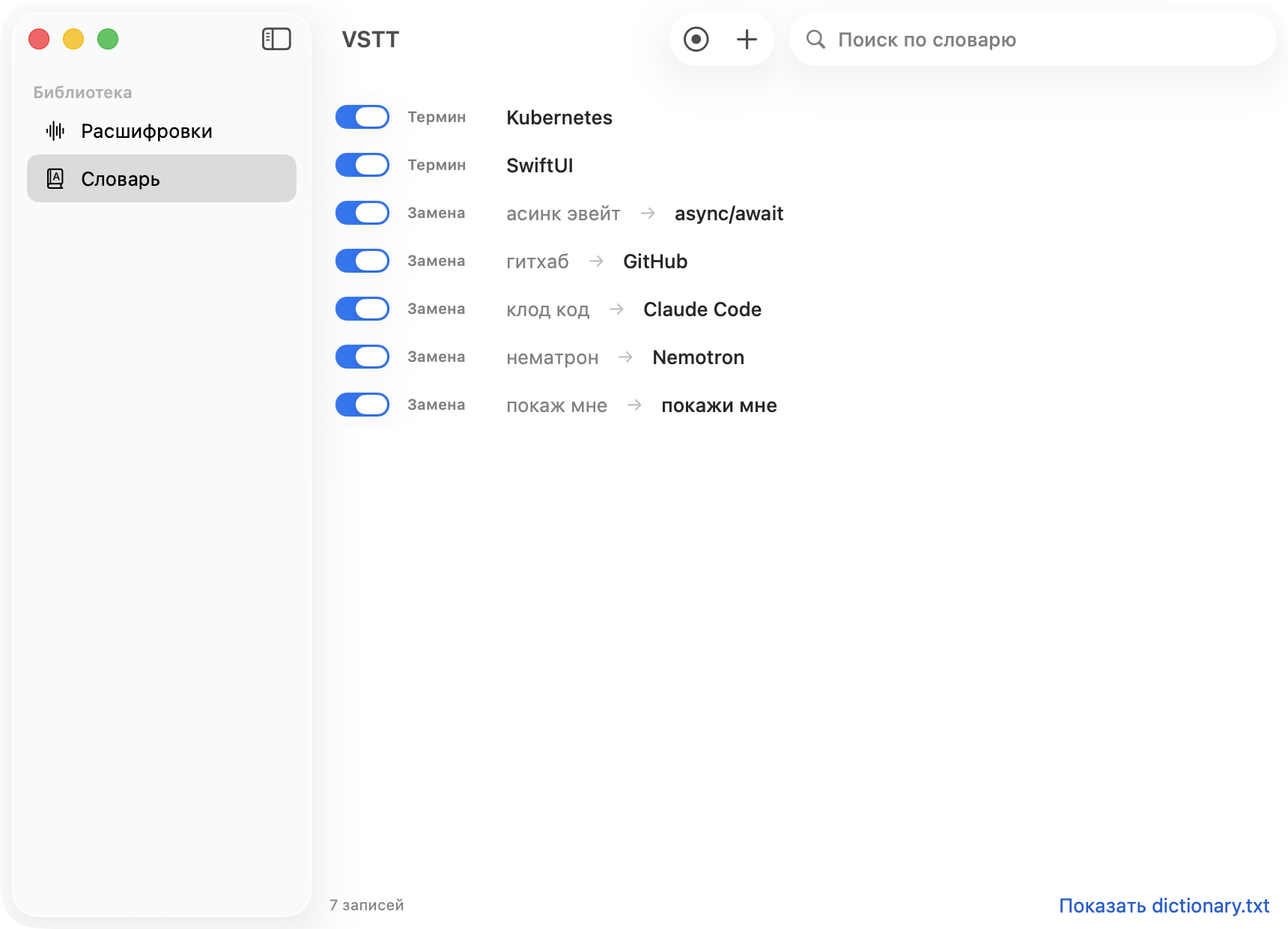
Two kinds of rule: corrections - when you hear X, write Y - and terms that bias the recognition itself in the right direction.
A deterministic pass strips filler and fixes spacing and punctuation. Optionally a smarter pass runs through an on-device Apple Intelligence model, on Macs that support it.
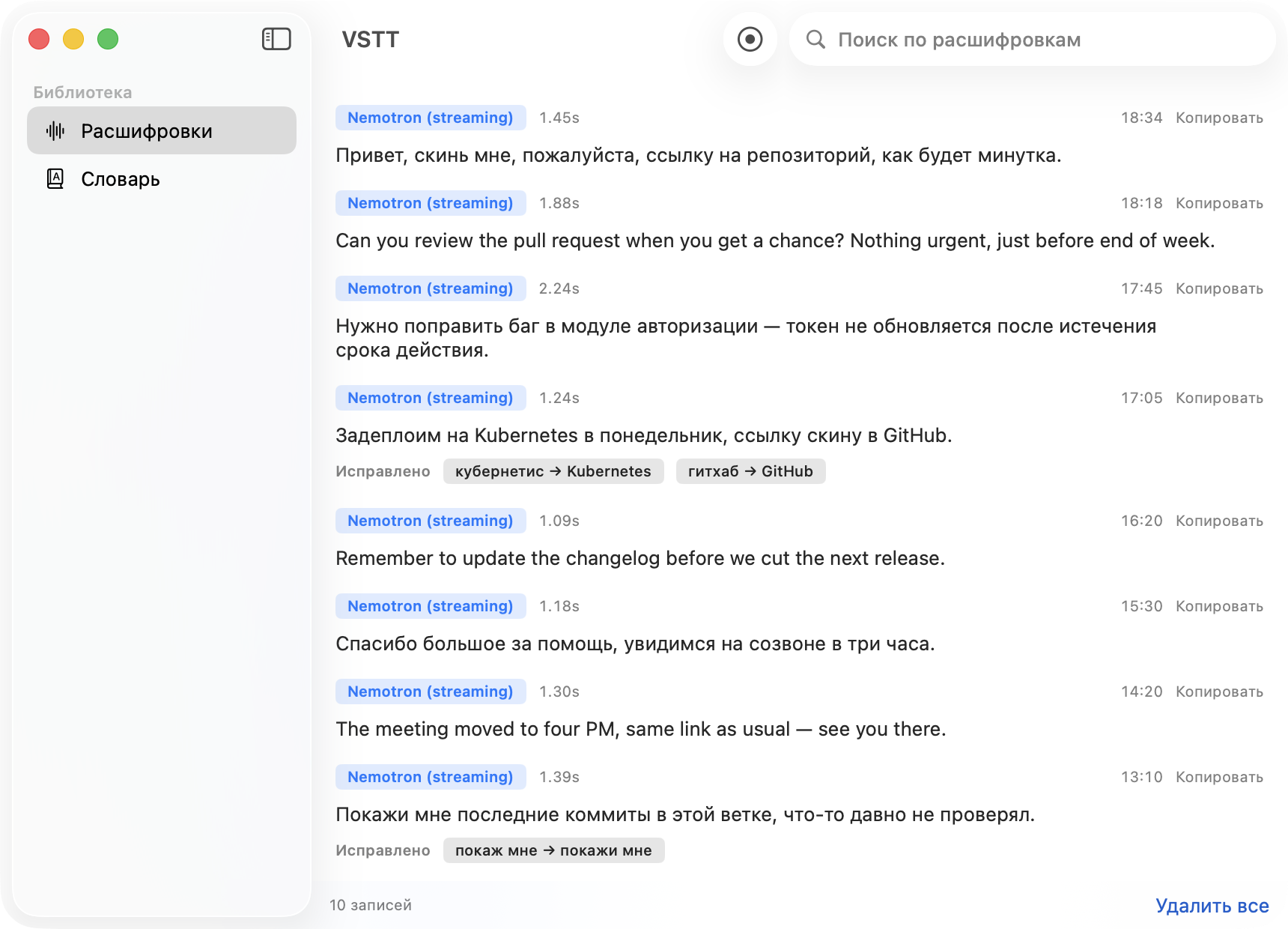
A searchable list of past transcriptions; any of them copies with a single click.
The interface language switches in Settings and applies instantly, with no restart.
With several microphones around - built-in, USB, a headset - VSTT records through whichever one the system has chosen, and follows it when you change that. Want a particular one? Pick it in Settings under "Microphone"; the device itself is remembered rather than its name, so renaming it, or owning a second identical one, changes nothing. If the one you picked isn't connected, dictation goes through the system's and the capsule says so.
After launch it's just a menu bar icon - no Dock icon. "Open VSTT" there shows the window; close it - ⌘W or the red button - and it settles back into the tray. The dictation key works either way.
Interface
Requirements
Download it, let the app fetch the model, then hold Right ⌥.
Requires macOS 26 or later.